She Brings the Stars
by Sam W. Pisciotta
Sam's second story with us—a journey about striving to connect across slippages of time and history—smarts like hot skinned knee under a blanket.
The Persistence of Memory
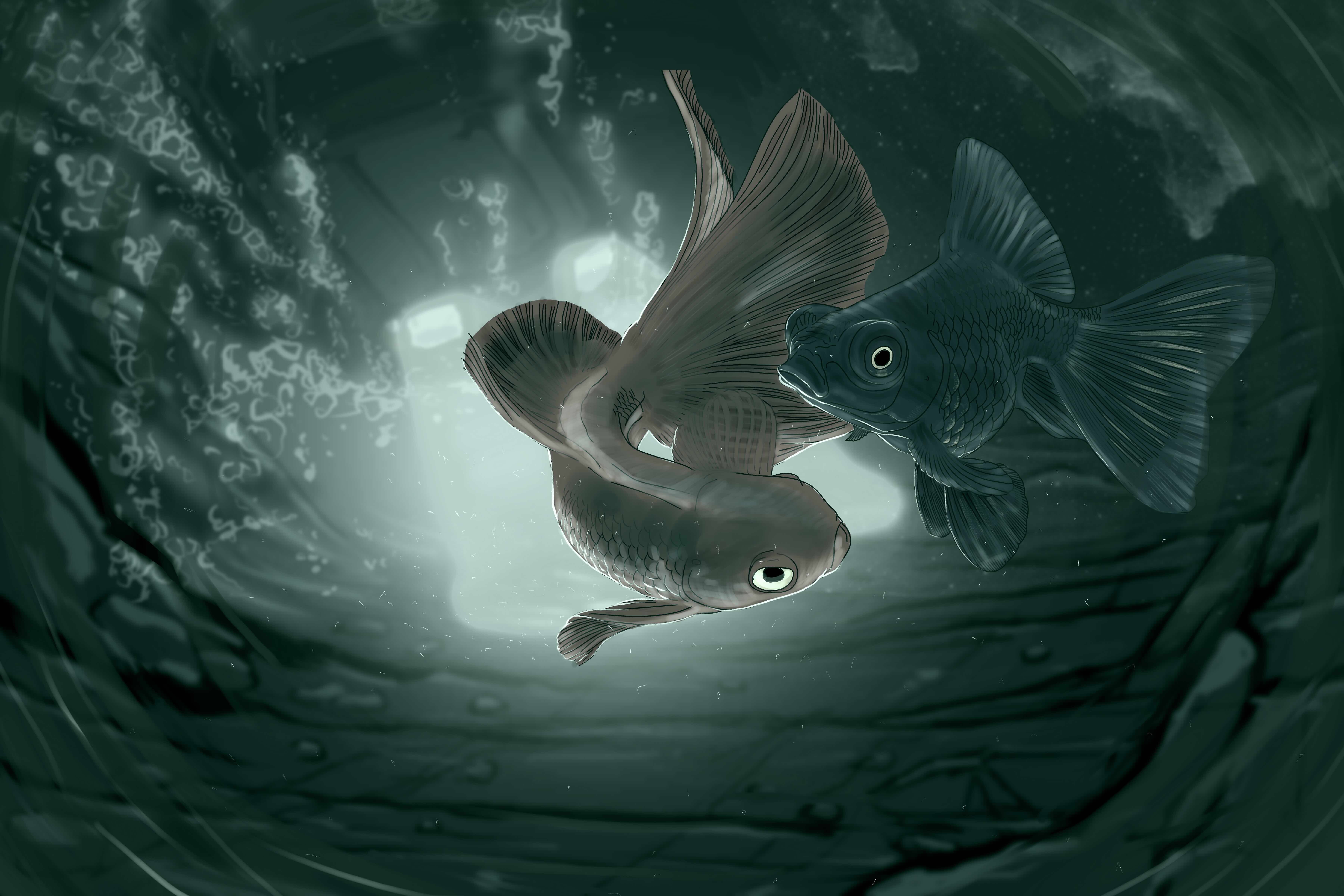
My mother lifts a cloth to reveal a bowl with two goldfish, a gift on my tenth birthday. She calls them Shakespeare and Picasso. One is golden and the other jet-black. We watch them swim and feed in water filled with sunlight. For an instant, the fish’s noses nuzzle, and I fall in love with them.
This is a memory that swims in tight circles at the back of my mind. I’ve been trained to hold it there, just within reach as the Keeper moss envelops my eyes. The sedative is little help as the moss spreads across my pursed lips and seeps into the corners of my mouth. I reach up to scrape it away, but my hands and arms are fully covered now, weighed down by the meaty flora. My body convulses, and then the moss, the sterile room, the doctors, and the military officers vanish. Only the memory remains, two fish suspended in water and time.
I hold the memory close as I’m ripped through spacetime. Their names are Shakespeare and Picasso. One golden and the other black—light and shadow contained in a bowl. The Keeper moss is only the vehicle; the emotion stirred by memory is the propellant used for making this journey.
I focus on the fish tilting upward and sucking in flakes of food. My mother kneels beside me, her hand on my back. These images—predictable, persistent—are all I have left of her. Then something different. My mother stands, places her hand into the bowl, and swirls the water. The fish dive for the bottom. This is not part of my memory.
“Mom?”
She kneels beside me again, touching my arm with a wet hand. She shakes her head and laughs, the sound of glass shattering on the floor, as if her voice hasn’t worked out the sound of laughter yet.
“I’m only wrapped within your memory of her,” she says.
Contact.
Yuri 247: A Systematic Review
The first of the asteroids, Oumuamua, passed through our solar system in 2017 like an omen. With eyes opened, we searched for other interstellar asteroids entering our neighborhood. Then came Borisov and ATLAS. Soon these cold and inert visitors arrived in greater numbers. Still, only one transmitted a coded isotropic radio-frequency signal. Only one called out to be noticed with a song rising above the universe’s primordial wooshoo—wooshoo—wooshoo.
Yuri 247.
“Proposal for Gravitational Capture,” Krenshaw, Rachel, et al. The Center for Applied Astrophysics, May 2057. Abstract: This paper seeks to determine the most efficient method of capturing an interstellar object passing through our solar system at sixty-three kilometers per second. The answer is a three-body capture. Nudging and altering the asteroid’s inclination angle until arrested by the sun’s gravitational pull. Once initial velocity reaches an appropriate reduction, the asteroid is nudged into its new eccentric orbit around Jupiter, allowing an ISO team to explore Yuri 247 and the message sent by the Lightkeepers, the civilization believed to have sent the message found emitting from the asteroid.
Doctor Vashti Tehrani (COMSATS, Islamabad) examined the symbols on embossed carbon plates forged into the asteroid’s mass. Tehrani found that the radio signal held the key to deciphering the Keeper’s inscriptions. Tehrani’s work revealed two distinct messages. She determined the first to be a greeting, repeated on a loop. Beneath that surface message, Tehrani found a second more complex communication. Once deciphered, a team of researchers from the University of Melbourne, led by Doctor Philip Brasseur and a team of xenobiologists, found that the message contained a recipe: instructions for creating an unsophisticated alien lifeform.
The scientific community considered (in postscript) how to pitch any rational government on funding the cooking up of an unknown alien lifeform as next steps. For nearly a decade, much of the discussion circulating around the Keeper’s intent and the cost of following their instructions only served as a roadblock for finding sponsors.
Models showed the lifeform described by the panels would not be a complex one—not sophisticated enough to inscribe a recipe on an interstellar asteroid. We weren’t being asked to recreate the Lightkeepers themselves, but rather something simpler.
Still, simple can be dangerous.
The situation reached clarity when Dr. Keesha Williams (Center for Molecular Imaging, Yale) created a 3-D representation of the original Lightkeeper plaques and then passed the beacon signal over the raised glyphs to project prism-like bands onto radio-sensitive receptors. This discovery of a third communication brought more clarity: the recipe would cook up a communications tool.
We would create a lifeform that would help us contact the Lightkeepers.
Light Fading on Wet Asphalt
With one hand on the wheel, my mother speeds through the curves of the road. A full moon illuminates the pavement that spills between cliff and sea, and my fingers clutch the edges of the seat. This isn’t right either. I was never in the front passenger seat on that night. We should be driving in the rain on rural Highway 93.
My mother—or rather the Lightkeeper within the memory of my mother—holds my hand. “There’s no need to panic.” Her voice is warm, like baked cinnamon rolls, which my mother made on my birthdays instead of cake. “You’re mostly safe,” she says, and her eyes dart toward me. “There’s still a risk, however. Please hold your memories at the appropriate distance.”
“And if I can’t?”
“I’m not sure how your species will react. The moss may hold you within these memories indefinitely.”
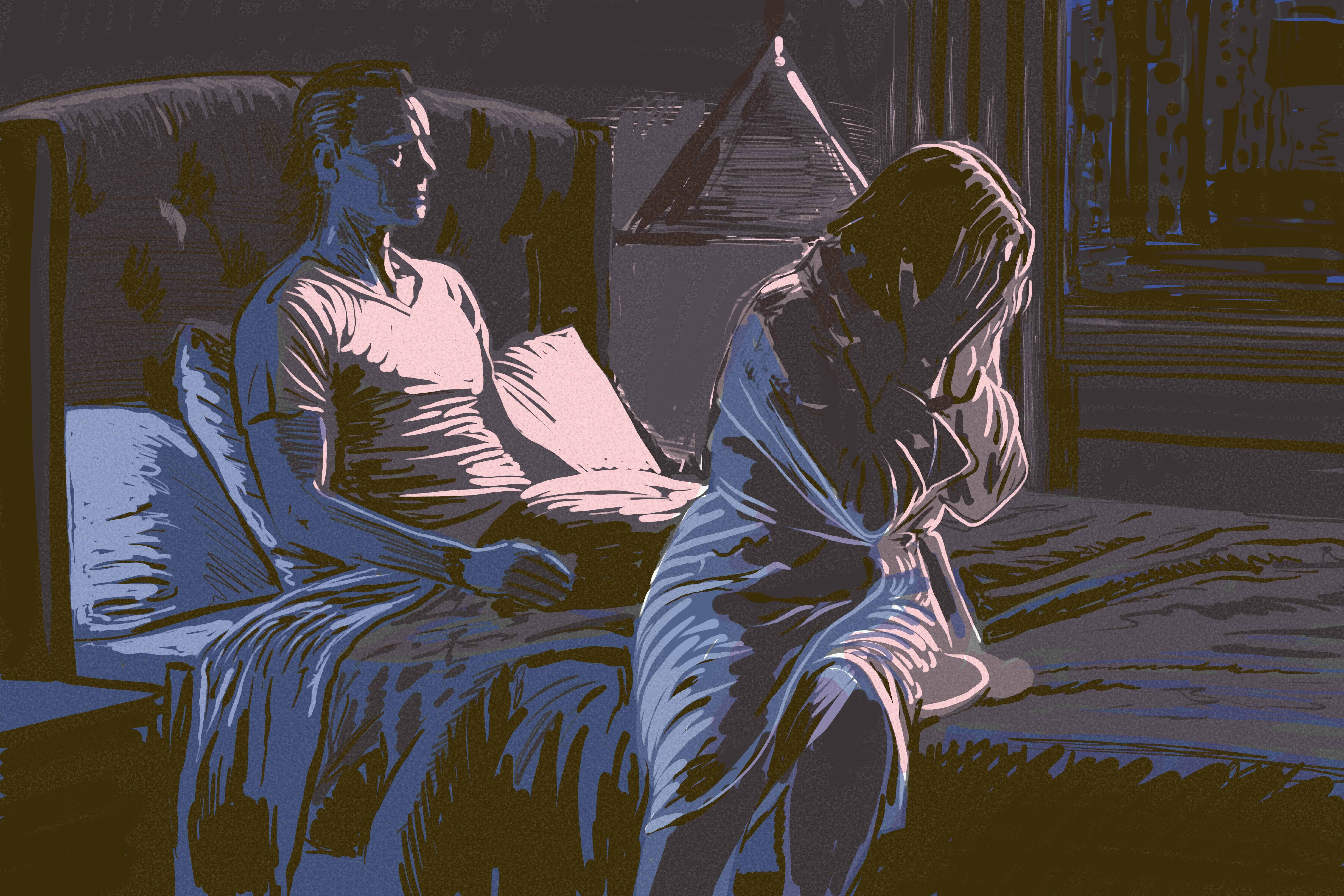
It’s the sensation of extended déjà vu—holding two time periods within a single moment. Behind my conversation with my Lightkeeper mother streams the memory of driving on Highway 93. My mother is sobbing. I’m in the backseat watching her wipe tears from her face. The car moves on the edge of control, and my weight shifts from left to right as we careen through curves.
I fight to hold my focus. “It’s too hard to be in both places at once. There and here. The past and the present.”
“Relax into the memory and let this moment overlay it. Mother and child. It’s the foundation your mind has chosen to allow us to communicate.”
“But I thought I would be visiting your world.” Perhaps she detects the disappointment in my voice.
“I’m sorry.” She wipes her cheek and looks at the smeared tear with curiosity, studying the moisture on her hand. “The moss has to interact with a neural system, and since you only have your own to offer, I’m afraid it will reveal these events through your own paradigm. Essentially, you interpret my thoughts using your words. You see my world utilizing images from your own memories. After all, you’re a creature of your world, just as I am of mine.”
Lessons in Poetry
My selection for this mission was pragmatic, more specifically, my cognitive aptitudes. After examinations and interviews, I was selected for my abilities to surf the extended waves of metaphor, to recognize the pure crystalline fractals that form between the juxtaposition of ideas. Emotion triggers the process and accelerates the effects of the Keeper moss. I cross spacetime on my past trauma, light and shadow—the memory of a mother giving me goldfish in the morning and then, by that evening, glancing back through a storm of shattered glass and twisted metal.
My meeting with the Lightkeepers is a mission of discovery and hope. We are not alone. My hand is the hand of all humanity as I reach across the void to touch the other, to seek warmth in an expanding universe destined to end in cold.
Floating Above the Wreckage
In the bright room of my childhood, shelves of action figures on sunshine walls, Mom kneels beside me to watch the goldfish. “Which is your favorite?” she asks.
“I love them both.” But the sunlight is so beautiful on Shakespeare, the golden fish. I point to it, placing my finger on the glass. The fish flits to the back of the bowl. My mother smiles, but there’s sadness in her eyes, and somehow, I know her favorite is the dark one.
Her countenance now appears subtly amiss. Still beautiful, but unnatural, a discomforting lack of recognition that tips into the uncanny valley. The warmth in her touch fades. The light shifts across her irises, and the corners of her mouth stiffen. She seems to sparkle with fine glitter, the day’s brilliant sunlight flashing from her cheeks and throat. There are inherent proportions ingrained into our neural pathways from the moment we lay eyes on our mother’s visage. We learn what constitutes human expression, a mouth, a nose, and eyes spread across a face like a unique yet familiar constellation. When those stars are altered, we know we are no longer home.
“Shakespeare. Picasso,” she says. Who are they?”
“A poet. An artist. They spoke about what it means to be human.”
“Mmmm.” We have this in common, I think. The need to analyze and explain.
“More than that. Poets and artists give us experience. Through their words and images, we feel emotion, an act of connecting, and we know that we’re not alone.”
Mother glances over her shoulder and smiles; I’m sitting in the back seat speeding through curves on Highway 93. The shift disorients me until I realize it’s my memory of speeding through the rain with my mother on the night of my tenth birthday. She maneuvers the car through unyielding curves and adjusts the rearview mirror, fixing me in her gaze.
She blinks, and the eyes no longer belong to her, my memory of her. The Lightkeeper mother turns back with a look of curiosity and pulls me back to the moment.
“I expected something different,” I say, now firmly in the front seat beside her.
“You sound disappointed.”
“Perhaps, a little.”
She pouts her bottom lip and flashes a sympathetic look. “Not the angels you hoped for?”
I reply with a shrug, “But also, not the monsters I dreaded.”
She pauses, and an expression of curiosity crosses her face. “It’s so strange how you pull us between narratives.”
“That’s the nature of our memories—ephemeral and intersecting. For me, the goldfish and the car accident are interwoven.”
“But they were at different points in time. Different locations.”
“Yes, but unalterably tied together. The two fish given to me on my tenth birthday are my bridge to the mother I lost in the car crash that night.”
She laughs again, and this time it sounds more authentic, but I’m unsettled by the juxtaposition of the laugh with the mention of the wreck.
“My mother died that night.”
“Yes.”
“Laughter isn’t the usual response.”
“I don’t know the usual response. I’m reading so many sensory details from you. If I chose the wrong interaction, I apologize.”
I wonder if I’ve made my own unintended mistakes in our new relationship. Even individuals bound by genetics and culture, even mother and child, feel the chafe between expectation and response. In the end, aren’t we all like Whitman’s spider? We stand alone on the ledge and send out filament, filament, filament into the night, hoping to make a connection.
“Strange,” she says. “Our minds are more partitioned than yours. If that makes sense. I’m not sure how to describe it so you’ll understand.”
“It raises so many questions about our similarities and differences. About our worlds.” I take a breath to calm myself. “Where are you right now?”
“I’m here. With you.”
“No. I mean, where are you actually? Your body?”
“If you want to know more about me, about my world, then you’ll have to raise your gamma.”
I have no idea what she means or how to proceed.
“The moss absorbs our theta waves to launch us into the cerebral space-time transport. Hence, the strong emotional trigger it requires to initiate the process. But it’s the jump to gamma that allows this shared experience, and a full sensory perception is only achieved at one hundred hertz. You must feel your emotions more deeply.”
The Lightkeeper reaches over to turn on the radio, and static squelches through speakers as she adjusts the dial. She locates the correct frequency and soft music lifts between us—the fourth Prelude by Shostakovich. Had this been the song on the car’s radio as it barreled through the rain that night? She cranks the steering wheel hard to the left, and we plunge from the cliff.
A death unexpected.
The rain veils our world, and the windshield wipers fight to keep it clear. My mother glances over her shoulder toward me. Her sad expression rolls to the side and turns away. My eyes open wide to gather the moment’s light and shadow. My hand reaches toward her through a world spinning out of control—the final act of encoding a mother who, with both arms flailing as the car rolls over, seems to be waving goodbye for the last time.
Control the memory. The voice edges around the scream of twisting metal. Ride on top. Don’t let yourself sink too deeply.
I reach back for the other mother, the one allowing me to surf these mossy waves. But my memory of that night consumes me.
My mother glances over her shoulder and smiles. In a house drenched in sunlight, in a room pressed by shadows, into a bowl filled with light, she sprinkles fish food onto the water’s surface. The flakes rise to the surface as the bowl turns over; the fish fight to remain in place, golden Shakespeare and jet-black Picasso drifting through shattered glass.
Pull back! You’re losing yourself. I reach for her words, a lifeline to the present. My body slams into the back of her seat.
The unexpected scent of ragweed wafts into a car lying right-side down in the tall grass next to a guardrail. The Lightkeeper takes my hand into hers and I rise from the wreckage. The engine whines high and tight over the surging tide below us. The shoreline drifts upward to meet our weightless bodies. Like a shooting star, the car arcs downward to meet the crashing waves. Near the horizon, a moon rises with liquid warmth. Remembered daylight. Inside its seamless sphere, float the shadows of two remembered goldfish.
All Who Wander
The drop from the cliff boosts my gamma waves and allows Lightkeeper mother to direct my consciousness to her world. She leads me through a crooked corridor of dark brickwork. It resembles the hallway of a middle school I attended, but the walls are dry and flaking, like lichen on a rock. We pass through a door and step onto a terraced deck surrounded by a city of lemon-yellow spires twisting into a copper sky. The spires glow with a sour light.
Lightkeeper mother leads me past tables where shadows sit and speak in murmurs: Within that time, the grey shades descend, someone says. How pure, how true these shadows fall, says another. See them sliding along the sunlit floor.
We sit at an empty table and she fills two cups with tea and offers me one. I drink.
“The others—the ones around us,” I say, putting down my cup and waving toward the shadows. “They’re so familiar. Recognizable. Beyond gestures and words.”
“Yes. Isn’t that interesting? And it seems to be true throughout the universe.”
Mother has taken on a jaundiced complexion. What I took for glitter is actually a galaxy of luminous gold flecks just beneath her skin. The lights swarm like fireflies across her cheeks and above her brow; they zip and stir the length of her arm to pulse at her fingertips. She notices my focus on her skin’s strange light.
“These are Sulphoids,” she says, brushing her skin with a finger. “They live in symbiosis with us and allow us to metabolize the sulfuric atmosphere. In exchange, our bodies provide them with the nourishment they need for life.” She reaches across the table and lets her pulsing fingers nuzzle mine.
“We’re so different,” I say and hesitate.
“And yet…?
Overwhelmed by this place, the memories and emotions that tether me to my own world begin to fail. Fear rises within me. I need to remember. I grasp for the morning of my mother’s death. Sunlight spills across the wooden floor. She turns into the light and smiles. My gaze moves past her to the end table where a fishbowl sits. Their names are Shakespeare and Picasso. The propellant memory slips forward—lights pulsing like blood from an artery, dark faces peering through shattered windows, the tight straps of a hospital gurney.
Questions and Answers
She asks, “What did you feel when you entered our world?”
“I felt like I was finally a part of something. That perhaps we’re not so different.”
“All life is the same,” she says. “Cosmic dust rising to its highest expression.”
Standing amid this alien world, her words feel true.
“But I also felt alone,” I say. “As if my fingers and eyes and ears weren’t sufficient.”
“It’s the reason we call to others.”
“And the reason we answer, I suppose.”
She turns to look over her shoulder at the child in the back seat, sorrow in her eyes, and something else, a more subtle emotion. Regret? The car begins to roll. Glass shatters. The smell of gasoline and snap grass. My heart pounds then pauses. Pounds then. Pauses. Arms flailing. Long auburn curls defying gravity. Pounds then pauses.
“We’ve made so many bad choices,” I say. “We hoped that meeting you would give us answers.”
“We’ve made our own mistakes. Taken paths are difficult to come back from.”
“But they led you to us.”
“Yes. And there may be others.” She turns to me and smiles. “You can find them.”
We’re still like children. They held our hand to get us here. “That may take a while,” I say with a scoff. “We can’t get out of our own backyard.”
She leads me to a lemony spire and encourages me to touch it. The gritty column floods my neural network with images and information stored within the fabric of their world. They’ve converted their planet’s geological structure into a massive data system.
“We’ll share what we know.”
I’m not sure we deserve any of this, and she must sense my hesitation. I finally manage to admit, “We can be a brutal species.”
“If you go down this path, it will change you. The most important thing you’ll find within these spires is the lesson of our extinction.”
Extinction. The loneliness that’s been pressing into me makes sense. “You’re not here?”
She bends to whisper in my ear. “We’re already gone. A collection of remembrances laced into your own memories.”
So, we are alone.
“Not alone,” she says, reading my thoughts. There must be others.
Swimming for Shore
Notes from a piano rise within the garden to usher me home. The melody pulls me into the past, bringing the memory of her forward. She stands inside a small house drenched in sunshine, in a room where sunlight passes through glass windowpanes. Long shadows inch across a hardwood floor in the late afternoon.
The warm light passes over us and between us—both particle and wave. It is a truth moving at 186,000 miles per second, catching the bowl’s edge to pass through water and illuminate an explorer of lost worlds.
She bends to whisper into my ear—now they are yours. Care for them until it is your turn to pass them along.
A mother holds her child, and the stars cease their fall toward entropy. That starlight, now fixed, illuminates a fishbowl with two perfect goldfish—one light and one dark—swimming near the edge of a galaxy.
Hands reach out to hold me, to secure me, to welcome me home. I gasp, and the veil falls away. I open my eyes to light and shadow. Every artist knows that both are required.
Picasso painted a child wrapped in his mother’s arms. Cool blues permeate the canvas, but this is a painting of fire and warmth. We exist apart from one another, with infinite space between us, but in Picasso’s painting, time and space collapse; there are no yesterdays and no tomorrows. The mother sits on the floor, eyes closed, her cheek nestled against her son. He’s wrapped in her cloak and wrapped in her love.
Contact.