The End of the Line
by Anna Clark
In a postscript to civilization, Anna Clark touches on what we owe to others, what we owe to ourselves, and what we owe to the end, if anything.
He’s the first person I’ve seen in over two years. Staggering from a bramble-ridden field, hair plastered to his cheeks, dirt filling out the peach fuzz on his upper lip. I know it’s been two years because of seasonal changes, not because I’m counting the days or anything. Marking such small measures of time seems a conceit for societies, not doomed individuals.
“Oh my God,” he says. “Oh my God, I’d just about given up hope.”
I wonder if he’s religious. Hope that he isn’t. I don’t want to find meaning in tragedy.
“You alone?” I ask, though his greeting all but announced it.
“Just me. No one else survived. I assume...”
“Yeah,” I say. “Same.”
“I can’t believe you’re here. Like, God, I thought I’d be alone until I died.”
“Yeah, same,” I say again. I sound flat. I feel flat. I know relief is going to hit at some point, but solitude has drunk the depths of my emotions and left me inhospitable. I think I might be depressed, which is funny, because my dad always said depression was an illness of luxury and heightened expectations, and the apocalypse broke my expectations, and he’s not here for me to correct, and that might be the worst thing of all.
But he—the other survivor, not my dad—must also have suffered unspeakable loss, so I tell him, “I’m Moa.” I flex unused muscles in my face when he gives me his name (Jack) and hope it resembles a smile. I take him to The Monument.
“It’s not finished,” I say, running my hand over the dry stone base. “One day, it’s going to stand above the treetops.” Once I figure out scaffolding.
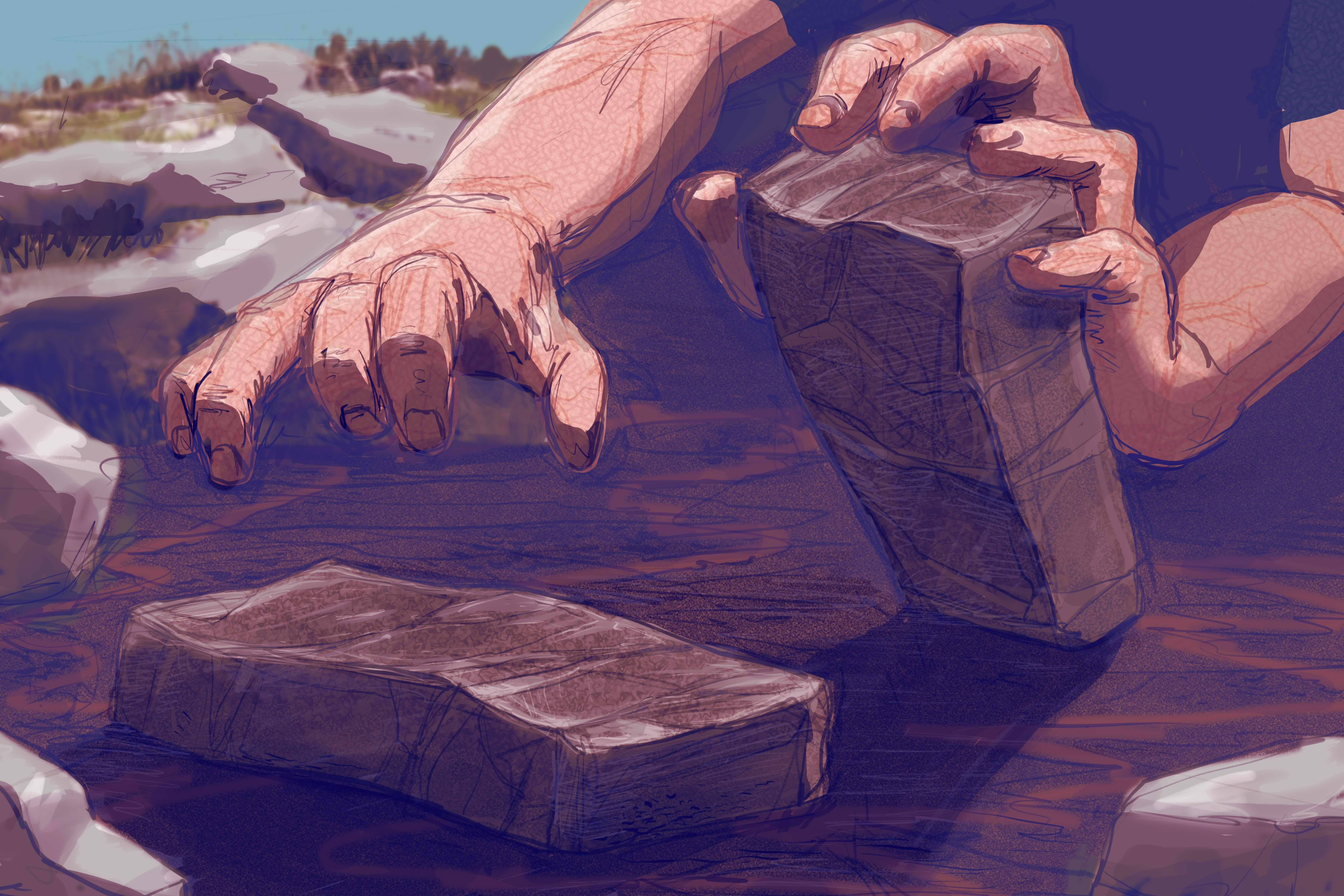
Currently topping out at my shoulders, The Monument is the labour of my isolation, my expression to an unreceptive world, a legacy without consequence. (Art is meant to be pretentious. Especially art absent of meaningful ability.) In real terms, it’s a shale cuboid, about as wide as it is tall, with a slight taper to its walls.
In the beginning, I drew inspiration from the obelisk-style memorials common to graveyards and city plazas, and I called it The Monument for the Dead, and then, in acknowledgement that memorials only serve those left behind, The Monument for the Living. At some point, when singularity had come to define my existence, it became simply The Monument.
But I’m no longer singular.
“What’s it for?” asks Jack.
Turns out disappointment can still feel sharp. I shrug and say, “Something to do,” because he doesn’t get it, and I can’t explain how I need to be something more than survival to a person whose only relation to me is that he survived too.
I flinch when his hand touches my arm. Nothing corrodes endurance like pity, and even before, I was never much for touching.
“When I was searching, I talked to trees and rocks. Talked to myself,” he says. “Loneliness friggin’ sucks.”
“Yeah,” I say, for a third time. It does. Especially the way it sits like a dampener between two people who aren’t alone. “You want food?”
-
There’s never any question of going separate ways. Humans work together if they want to survive, and on some level, to have made it this far, we both want to live. That might be the only thing we share.
He’s twenty-two, younger than me by eleven years, a fact I can say with precision after he marks out the date on the side of a yew tree. We’re in May. His birthday is June the fifteenth. I don’t tell him mine.
He misses the sound of traffic, sometimes finds its absence eerie. (“Like, I know it was bad for the environment. But it was reassuring, you know?”) I don’t. I’m particular about background noise. Always have been, and not just for concern after the environment.
He chatters. Relates life to movie quotes in a way that assumes a shared frame of reference, that context can be surmised with a title, that we’re still following a tested narrative. Reciprocating feels impossible, but I start saying “okay” rather than “what?”
“So I was trying to light the fire and—hey, g’morning—and there were these massive clouds over the trees that were, like, looming and oppressive, and the fire wouldn’t catch, and I just had this feeling like the world was against me, you know? Then I remembered that line in that film with Glenn Cassidy, how he said—”
“Okay.”
“Don’t you think this is like—”
“Okay.”
“G’night. ‘May the stars guide high your dreams.’ It’s from Moon Monks IV.”
“Okay.”
I don’t mean to be poor company. Only, I miss the quiet of my closest friends; miss my friends, and resent how Jack seems able to miss people generally when I’m still confined to missing them very specifically.
-
When he goes silent one dinner, it should be a relief. The food is soup and the air is soupy, pregnant with precipitation and the promise of a summer thunderstorm. Something more than idle chatter is brewing in the stillness. My mind is full of The Monument and the timber scaffold I’m erecting from oak, but I notice Jack’s swallows are more frequent than his sips.
I need to buttress the base before I go higher. One on each side? Two?
Jack’s nervous. His hands take turns smoothing down his trousers, toying with his spoon.
I wonder if I should learn how to coppice. I wonder if the rain will give me an escape.
He breaks before the storm. Clears his throat.
“This might be it,” he says. “Us. Maybe the last man and woman on Earth.”
“Okay,” I say.
“I mean, pretty lucky, really, right? Like, maybe not lucky. But you could be another guy, and then we’d really be it, you know what I mean?”
“What?” But I pick up something of the insinuation. His company has gone some way to replenishing my emotions, because I’m embarrassed, and how’s it fair for that to survive the death of civilization? It’s an effort to relax the grip on my tin. An ex-colleague once called me curt to the point of bitchiness. Perhaps, if I’m sufficiently abrupt, Jack will drop this before rejection makes our differences personal.
“I’m not...” Jack scrubs a hand over his face, dragging down the corners of his eyes like a Melpomene mask. “I don’t want to sound creepy. But we might be the last man and woman around.”
“I suppose,” I say.
“You never talk about your family. Did you have a partner?”
I level him a look. “Don’t beat around the bush.”
“I’m not saying I’m horny!”
“I’m not interested in you.”
“That’s cool! You’re not exactly what I—" He breaks off to stare at me in mortification.
Not exactly what he wanted in a fuck? A partner? To find himself with at the end of the world? Yeah, same. Perverse empathy catches my chest, squeezing out a laugh. Not at him, precisely; at our mutual discomfort.
“Worst come-on I ever heard,” I say, but I try to keep my tone light. “I can’t be that person for you. No hard feelings.”
He returns a pained grimace. Tension still strains under the taut skin of his knuckles, in the brackets at his mouth.
“I wasn’t trying to hit on you, exactly,” he says, then clears his throat. “Well, kind of, but— What I meant to say is that we might be the last people alive. And we’re a man and a woman, and it might be on us to… you know… God, like, stop the extinction of our species. Have kids.”
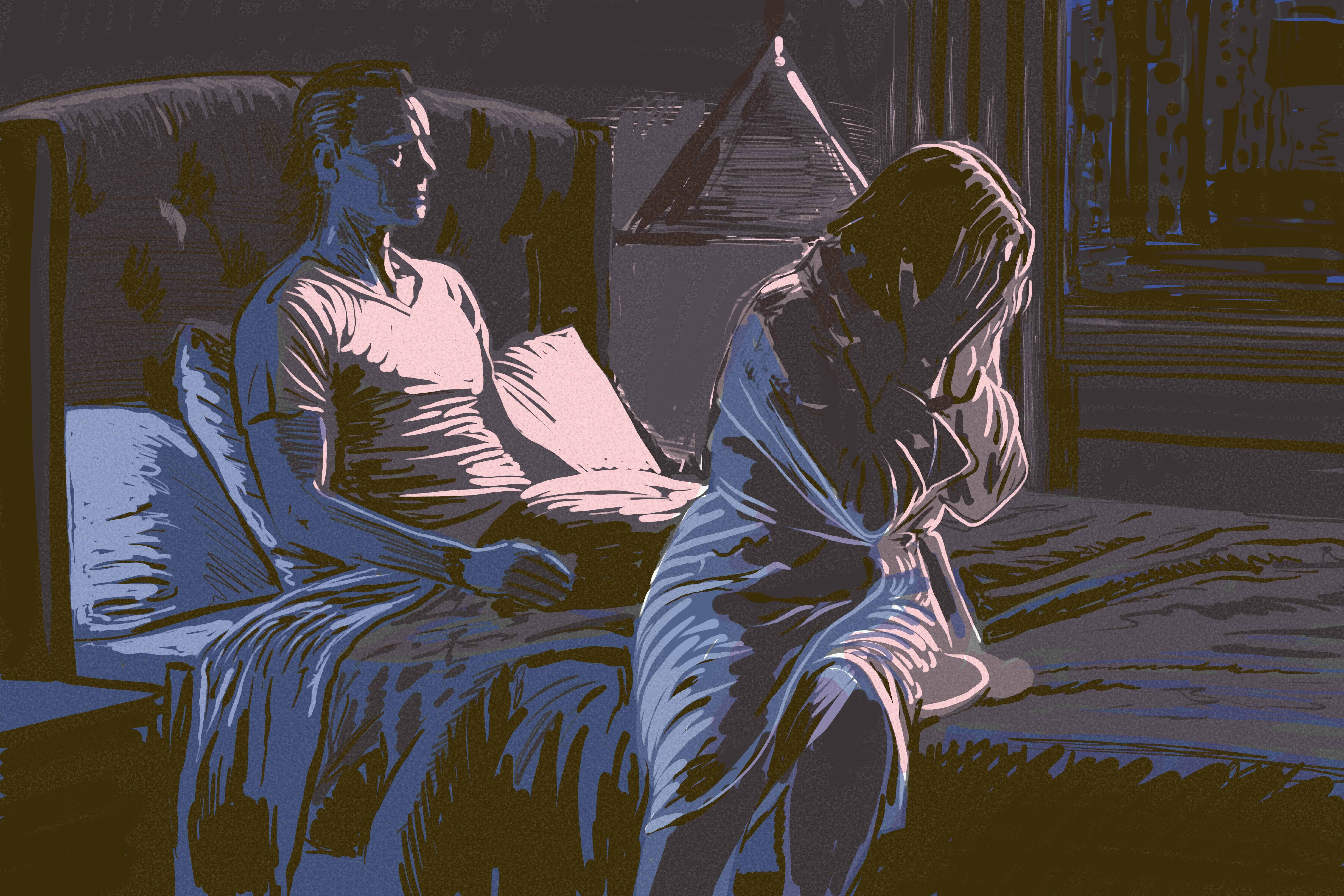
Horror takes my tongue, and all I can do is gulp thickly around the concept of pregnancy, ever, let alone now. It’s always been something of a personal phobia, even separate from parenthood. The rearrangement of organs, the sapped nutrients, the hormones fucking with your head. I don’t want it. Any of it. Every romantic entanglement of my life has come with a clause: no children. And we aren’t romantically entangled. And there’s no cushion of civilization, no bright future. And I just don’t want it.
“No,” I finally get out, and push from my battered camp seat. Buttressing. One on each side. Better get to it. I leave him to extinguish the cooking fire.
-
Late afternoon the next day, when he finds me digging channels for the new supports, I’m still listing the reasons why children are a terrible idea for the last survivors of an apocalypse. The Monument is losing any resemblance to an obelisk, mutated by the wooden scaffold and the beginning-spurs of buttresses, and I guess it lacks unifying vision, but I like how the additions contribute scale. That’s another reason—genetic mutations. Under the subcategory of “no medical access.”
“I think it’s really cool that you keep going with this,” he says from behind me.
I rest a steadying hand against the stones before turning to face him. The sun is low at his back, in bright apology for last night’s storm, and it limns the slump of his shoulders with gold. My own shoulders tighten.
“You can say it’s weird,” I say. “But thank you.”
“I’m not sure things can be weird anymore. What’s normal?”
“True.” I manage a smile. “I was weird before, though. Feels wrong to be the standard.”
“It’s between you and me,” he says, and flinches.
“Jack—” I start, but he rushes ahead.
“I’m sorry, I heard what you said, and I respect you, and normally I wouldn’t say any more about it. Except it’s now, and there isn’t normal. We’re going to be extinct. There won’t be people after us. What’s the point of us surviving? Where’s the future?”
“Incest,” I say.
“What?”
“Figure it out. It’s your plan for humanity.”
A flush creeps up his neck. “I wasn’t... You don’t understand. I looked so long for another person. I can’t be the last.”
“So you’ll push it back to your children. ‘Hey, kid, here’s your choices: you can die lonely or fuck your sibling.’ That’s supposing you even have one of each. Some fucking future.”
He takes a step back, face pinched and startlingly young in its dismay. Good. I want to impress upon him the bleakness of his proposition. Horrify him. Get him to back off. A quiet, hiccup-like noise escapes his throat. It doesn’t feel good.
I open my mouth, but what can I say? Sorry? I meant every word. Somewhere, there’s a dead woman who, if we switched, would’ve handled this with tact and sympathy, but Jack’s stuck with me and my social inadequacies, ingrained long before isolation etched them deep.
His Adam’s apple moves up and down like a bell pull, and when it comes, his speech is low. “Did you prefer it before I came? I know you don’t like me.”
He says it with a weight of vulnerability I don’t think I can shoulder, and I answer, “No,” as a defence, only afterwards considering whether it’s true. It’s hard to evaluate beyond the immediate discomfort. Before his arrival, things were… almost hard to define. A tangle of grief and guilt and boredom around a central thread of purpose, first to survive and then to build.
Things were also muted. There’s a spectrum of emotion I hadn’t missed, exactly, but, returned, feels unquestionably vital. Oh. Even if it’s him. Even if he isn’t the people I loved and lost. I wouldn’t rather be alone.
Testing the words, I say, “I’m adjusting. To talking and listening again. I wouldn’t say I dislike you.” Or I shouldn’t, when he isn’t suggesting I birth children—when all he’s doing is being a person unlike the ones I chose.
He just looks at me like a kicked dog, eyes bleak and wisps of moustache drooping.
“You know, Jack,” I try, feeling for a way to mend this rift, “the future of humanity likely doesn’t rest on you. Or us. Seems statistically improbable for the two remaining people in the whole world to find each other. There’re probably others, spread out somewhere. Maybe getting it on even now.”
“You think?” he says.
“Yeah. Take a breath. It’s not your burden to bear.”
I’ve never been physically demonstrative, but I steel myself, step in, and pat his shoulder. When he exhales and closes his arms around my middle, I keep patting.
-
The following days are raw in the way of a recently cleaned wound. There’s a sense that we’re both stepping cautiously, making accommodations, me talking a little more and him talking a little less.
I begin greeting him first in the mornings. Sometimes, the greetings constitute whole sentences. He catches himself in the middle of monologues (“Did you watch—? Oh. Never mind.”) I reference my parents, and push back the accompanying twinge in my nose that preludes tears. One grey evening when grief washes down with the drizzle, I tell him how I used to tire of my co-workers. How I would take myself off to remote parts of the downs and pretend I was the only human in the world. I tell him how thoughtless I find the memories now. I’ve blunted his expression, and he’s brought out mine, and it’s definitely not a fair exchange, but I’m just so relieved that the topic remains dropped.
Gradually, I stop trying to overlay the shapes of friends and family when I look at him, stop seeing the angles that can’t fit my void. I find things I appreciate. He’s better with plants. I’ve found some success cultivating crops from untended fields and allotments; I can water and watch out for major pests, but he sits with them, picking off yellowing leaves and aphids hiding under stems. On his cooking nights, he’s more inventive with the scavenged stockpile of canned foods.
He struggles during between times. This is not a high octane life, stripped of wider societal ambitions. Sometimes he paces agitated circles; other times, he sits in listless contemplation. I work on The Monument.
Today, he watches me, picking moodily at the skin of his arms.
“What’s up?” I force myself to ask, because I should, because I’m the only community he has.
“You don’t want to know.”
“Okay,” I say. I tried.
He stops picking and rubs at the reddened pinch marks. “I was thinking about those people that might be out there.”
“Oh.” I suppose I should have anticipated this, having uttered into being the possibility of other people like some simple placation. Hard not to imagine where his thoughts might go. Can’t even blame him, though my tongue feels thick when I ask, “Are you going to look for them?”
His crumpled posture snaps to alertness. “Would you? Like, us go looking together?”
I consider it. If I stay, I’ll just keep going like before, emotions thinning with atrophy, until I don’t, leaving behind the record of my bones, and The Monument. If I leave, nothing is guaranteed. It would be hard to manage our resources on the move. It would be harder for me to leave The Monument. But there’s a person I can only be in the company of other people, and perhaps that person is more human.
Then, if we’re successful, what kind of survivor would we find? I wasn’t an easy fit in most groups, before the end. It was only through luck of population density that eventually I found my people. Dead now. I’m not an easy fit with Jack, but I’m older and better established and, here, that’s power. What if other survivors are more in line with his way of thinking? What if they try to determine my role? What if that role is mother? It’s all too easy to picture Jack there, nodding earnestly, saying, “It’s, like, for the best.” The small of my back is sweaty from labour. Wind breathes like a predator on my spine, and the skin there tightens with cold.
“No,” I say.
Jack doesn’t wilt as visibly as he’d stiffened, but for a moment, flanked by the green of new growth, his youth departs. But he rallies, nods, and says, “Cool. Yeah. I get it. Things are stable here. We’ve got a base. You’ve got your thing.”
Cold fear, hot guilt. Here goes Moa, crushing hopes and dreams at the end of the world.
“You could go,” I say.
“Nah. Not by myself. I might not find anyone, and like, God, what if I couldn’t get back to you? I’ve done that. Two years of never getting my footing, everything uncertain.” He crouches into the long grass and wraps his arms about his knees. “You know what I miss? The only thing—having purpose.”
A weight dragging on my shoulder reminds me that I still hold a block of shale, ready to be slotted into The Monument’s climbing crenellations. I heft it against my thigh, look down at it; look back at Jack, a despondent bump in the greenery.
“Let me tell you about The Monument,” I say.
His eyes flick up, just briefly, and I take that as agreement to begin.
My dad used to say that anyone with the time to be unhappy needed to do something constructive. He believed it, too. Spent his entire life outrunning social unease through building maintenance, with an unacknowledged desperation that left me uncertain as to whether it worked. But in the shock of my unaccountable survival, in my grief, in the unbearable absence of my mum’s gentler counselling, his persistence proved a memory to hold to, and his advice, words to live by. I took it literally and began construction. Like I told Jack before, like I tell him now, stacking rocks into the sky was something to do.
“And it’s more than that,” I say. “Its meaning kinda changes depending on what I need, but it’s evidence I existed. That I was here after the end, and I kept building even without civilization. It’s my record of humanity. Proof I retain mine.” This is the first time I’ve articulated these thoughts, and I feel vulnerable, uncomfortably aware of the furrow shadowing his brow. I press on. “I think you need your own thing. Something tangible that makes you feel human.”
Perhaps I should’ve considered that my dad’s brusque philosophies once frequently provoked my anger, but it’s not the reaction I expected from Jack. Mostly because I’ve never seen Jack angry. It sits under the flesh of his face like a second skull, soft turning hard, features drawing down and in.
Regret squeezes my throat. He still doesn’t get it.
“I’m sorry,” I say. “Maybe that sounded like dismissing what you feel, implying that a fix is easy, and that’s not what I meant.”
He shakes his head. Opens his mouth, closes it, opens it again. His voice emerges crackly. “I don’t get how you can say all that—that stuff about leaving a record and valuing your humanity when you don’t seem to care about a human future. Like, I didn’t want an argument, but do you hear yourself? I wasn’t just thinking about those people who might be out there. I was thinking about their children, and them having to choose between loneliness and incest, just like you said. There was this podcast I used to listen to, and they had this scientist on, and he was talking about declining birth rates and the worst-case scenario, and that scenario was a bottleneck event. We’re in a bottleneck event. Every birth and bit of genetic diversity counts towards survival. You said it yourself! There must be other people counting on us.”
His braces his hands in the grass behind him, chest heaving, eyes wide, like even he can’t believe the landfall of words fallen between us. I clench the rock so hard that its laminated impression must be defined over my fingerprints. So much for cleaning the wound.
“I’m not having a child with you,” I say, through lips that tingle with anger.
Jack takes a shaky breath. “Why not? No one is going to remember you. No one is going to care about your stupid monument. Why not make your efforts mean something real?” He shudders, and something shifts; he touches his forehead to his knees, and when he looks up again, his expression is slack with entreaty. “Please. You don’t have to do anything once they’re born. I’ll care for them. You don’t even need to have sex with me. I can do my thing and you can—you know, artificially.”
“Like a farmer with a cow.”
“Yes. No. You’re twisting what I’m saying!”
“Okay. I’ll try again.” It feels as though my sinews have tensed beyond their limit, and I’ve popped loose to float in a density of white noise and fury. “One. I care about The Monument. That’s all the meaning it needs. Two. Who’s going to feed this kid? Whose body? And if the birth goes wrong and I die, how will you nurse it then? Three. You’re out of your mind.”
“I’d—I’d find formula.”
“Easy for you to contemplate my death.”
“Jesus!” He throws up his hands and shoots to his feet, scattering grass seed to the wind. “You aren’t going to die. Women give birth. It’s natural, and when you’re healthy, the risks are, like, really small.”
With his clothes askew and his auburn hair corkscrewing with damp, he seems as wild as the untended country rioting on the horizon.
I retreat a step, sinking back into bodily awareness as I’m forced to look up at him. “But it isn’t you risking bleeding and diabetes and preeclampsia. Without healthcare.”
“Yeah, okay, it’s not. But it’s also not likely! There are, I don’t know, thousands of generations of people who had kids for us to exist. We’re what’s left of them—maybe all that’s left of them. We’re their legacies, their memories—or we carry their memories—we’re their hope. Like, I know you cared about your parents. Don’t you want a bit of them to stay in the world?”
“Don’t bring my parents into this.”
“Did your mum talk about grandkids? My mum did.”
I bite my cheek so hard that a coppery tang settles over my tongue. My parents had known where I stood on the subject of children, and neither tried to persuade me otherwise. But they felt an absence. I remember them putting off retirement, though they had the savings for it, remember encouraging them to start living for themselves, and them asking what would they do for themselves—all their friends’ time was taken up with grandchildren, so why not keep working, keep some momentum? There hadn’t been a sense of recrimination, embedding a thorn beneath my conviction. It wasn’t enough to change my mind.
Fuck. Fuck him. He doesn’t get to evoke my conscience on this. Not when I wouldn’t for them.
“You can’t guilt me into having children,” I say.
“I shouldn’t have to guilt you!” Jack stalks across the broken ground surrounding The Monument, kicks a tuft of creeping bent, and stalks back again. “This is, like, basic biology. You should want our species to survive. You should want to have a family again. I never pictured it would be like this, either. I thought I had time, and I’d have kids when everything was right and I’d met the right girl and I had a good job.” His voice cracks. “I thought I’d take them camping and show them my favourite films and games. I can’t give them everything I wanted, but I’d love my kids. What’s wrong with you that you don’t want any of that?”
I shake my head. “I just don’t.”
There’s more, and there isn’t. I don’t want to create another human inside me, don’t want to bear its weight, don’t want the weight of its future. Now more than ever. A little piece of me hurts for Jack, but the larger part is scared. He’s not letting this go. Again, I feel the weight of the slab. See Jack, the agitated shifts of his pacing, the wiry tendons flexing and contracting with the play of his fists. Could I raise my rock in defence? Would it be enough?
“I’m going to be very clear, Jack,” I say, and though the words seem to come from a distance, I feel awfully earth-bound. “I’m not having children. Try to force me, and I’ll die first. You don’t have the resources to keep me alive if I don’t want to be.”
I don’t know if I sound strong or ridiculous. I don’t even know if it’s true; I wouldn’t be here without a driving instinct for self-preservation, despite everything else. But I need him to believe, because I can’t bear to find out.
Jack stills, swaying like a child just off a roundabout.
“You can’t—” he starts. “I wouldn’t— How could you even— I’d never!” That last comes out as a shout, resounding off The Monument before being swallowed by the brush.
There’s a hung moment where there should be an echo, into which I say, “Okay. Good.”
He tugs violently on the hair at his temple, showing no sign he hears. “I can’t believe you said that. Jesus. To suggest that I’d force you. Jesus.” The shock finally tears away and he stares at me like he’s never seen me before. “God! You’d rather die than try for a future. You’re just going to— to play with rocks while we fade from memory!”
Jack lurches forwards. I shove myself away, but he’s already past me, ripping a stone from my last row and hurling to the ground. It splits into three pieces. He grips another one, turns to hurl it. For a moment, we’re facing each other, rocks raised like cave people before a brawl. I hesitate.
Face terrible, he flings his to the side. “You don’t get to build a legacy.” Another piece of my monument. Another crack. “It’s not fair.” He wrestles with a wooden strut, turns a puce shade of strain, and uproots it from the soil, dislodging two more blocks from the loose top row.
Each crack triggers a response inside of me, in the pillar of my being: something shearing away.
Dully, I wonder if I should try to stop him. There’s a protest somewhere in my chest, I’m sure, and a stone in my hand. I was so angry before I was scared.
But I’m right back in the lethargy of grief. I stumble away while Jack continues his demolition.
-
I end up hunched beneath a blackthorn bush. The air is mild. Above me, sloe berries are beginning to flush purple. My legs smart, latticed with scratches from where I pushed, unfeeling, through a field gone to shrub until the greenery muted the destruction.
I balance pebbles atop my shale slab and turn over a bleak calculation. Stay, together, or leave, alone. Like earlier’s proposal, but reversed. Each, with fewer consolations, and a loneliness quotient far exceeding the time before I had a companion, even if he was never my choice. Out there, I’d have to find new food, begin again to cultivate the land, wish for connection, and hope nobody finds me. Here, I have to live with Jack.
The sun dips and swells. I remain, taking some comfort in the open sky.
At dusk, thrashing splits the quiet. I hear Jack calling my name. I don’t answer. He keeps calling, high and desolate, and soon torchlight crosses beams with the moon.
Goosebumps are rising beneath my welts by the time he discovers me. I haven’t the inclination to move.
“Moa!” His voice is torn and thready. “I thought you were gone.”
I put my arms around the cairn of pebbles.
“God, Moa. I’m sorry. So sorry.”
“Does it matter?” I ask the cairn. “You don’t like my future, and I don’t like yours.”
The small hiccup noise. “I won’t talk about kids anymore, I promise.”
I don’t respond, and he begins to cry.
“Please,” he whispers. “I don’t want to be alone again.”
The saddest thing is, neither do I.
Eventually, though, he puts his jumper beside me, and leaves.
-
Sometime in the early morning, I compose the argument I wish I’d conjured during the fight. Of course I care about humanity. But there’s humanity as a collection and humanity as a condition, and at the end of the line, if one must be placed before the other, I choose the latter. Probably would have gone down like a lead balloon, but it galvanises me to stretch stiffened limbs and pay heed to the hunger pangs pounding hollowly under my diaphragm. Small decisions. My decisions.
On tender legs, I return to the settlement. The fire pit is cold, the ashes from the day before yesterday piled against one side. Jack hasn’t eaten.
I don’t want to go inside to the food store or my bed. Don’t want confinement. Instead, my feet carry me to The Monument.
Rendered black in the twilight, the damage is both stark and less than I’d feared. The scaffolding clings, partially dismantled, to a lopsided body, crown uneven; a sandcastle clipped by a careless walker.
There, also, is Jack.
He looks very small, bent double, stacking scattered rocks into a pile. I don’t approach. Perhaps he sees me. Perhaps not. He continues until the stack is to his hip, then straightens to begin transferring slabs to The Monument’s depleted top.
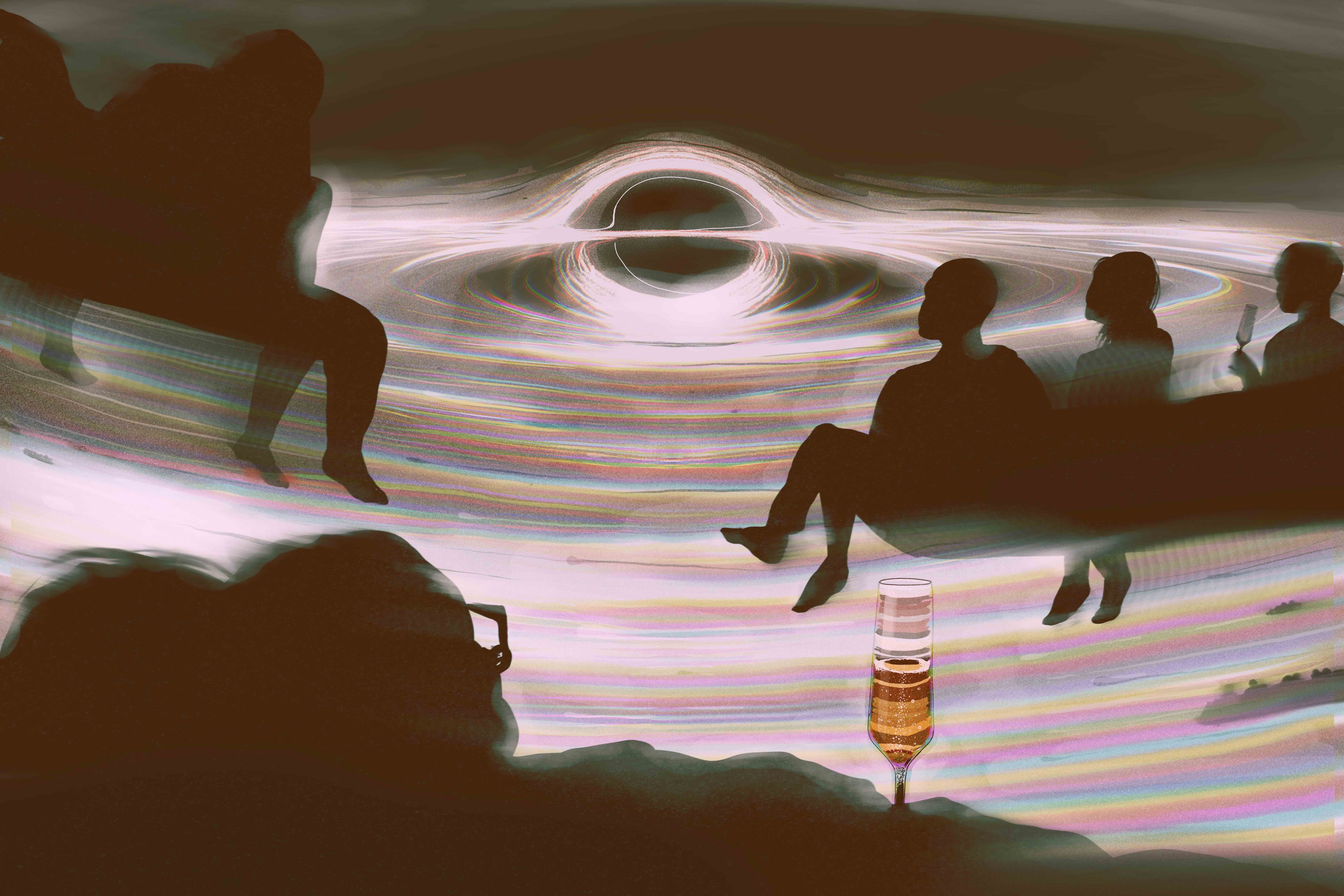
We remain this way for a span, in the space between his choices and mine. Grieving a past and a potential future. Two lonely people at what might or might not be the end, one watching the other labour as the sky turns pink and births the sun.